
Seaplane Wreck in Busuanga
Seaplane wreck in Busuanga, paddling through history Exploring an abandoned seaplane in the tranquil waters of Busuanga Bay
Where is the Seaplane Wreck in Busuanga
Tucked away in the quiet waters of Busuanga, just a short ride from Coron, lies one of the island’s most intriguing secrets: the wreck of an abandoned seaplane. Unlike the famous World War II shipwrecks that draw divers from around the world, this relic rests in shallow, sheltered waters, accessible not by scuba gear but by kayak. The journey itself is part of the magic gliding across glassy turquoise seas, framed by limestone cliffs and mangrove forests, until the silhouette of the aircraft slowly emerges beneath the surface.
The seaplane sits partially submerged, its fuselage broken but still recognizable, wings stretching out like ghostly arms beneath the tide. Coral and barnacles have claimed its skin, transforming cold metal into a living reef. Schools of fish dart through the cabin windows, while sea grass sways gently around the landing gear. It is a haunting yet beautiful sight, a reminder of both human history and nature’s resilience.
Kayakers can tie up nearby and slip into the water to snorkel around the wreck. The shallow depth makes it easy to explore, even for beginners, and the clarity of the water reveals every detail, from rusting rivets to the way sunlight filters through the cockpit. The atmosphere is serene, almost meditative, as you float above a machine that once soared through the skies but now rests quietly in the embrace of the sea.
The seaplane wreck of Busuanga is not marked by crowds or tourist infrastructure, but by silence, solitude, and the gentle rhythm of paddles on water. It is a place where history, mystery, and natural beauty converge an experience that lingers long after you’ve returned to shore.
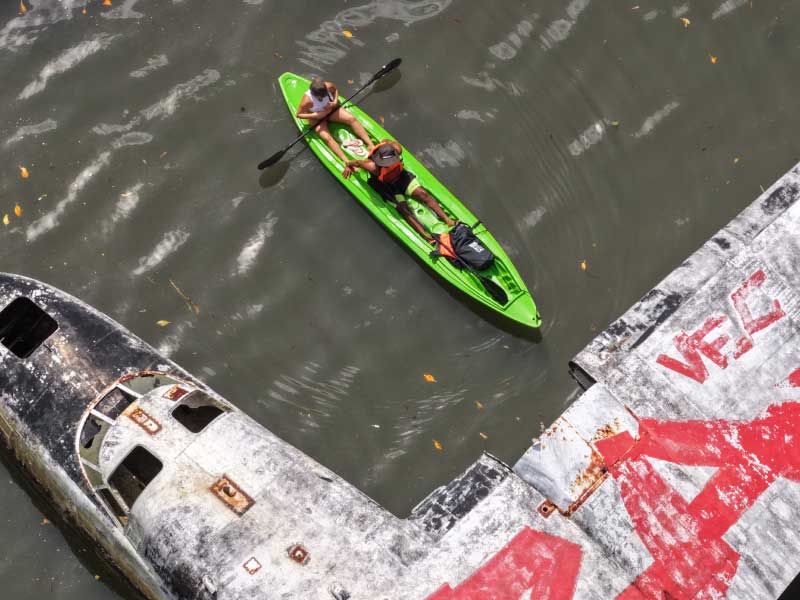
About the Seaplane Wreck in Busuanga
Locals and travelers commonly identify the Busuanga Seaplane Wreck as a Grumman Goose (G‑21), an American Amphibious aircraft widely used from the late 1930s through World War II and into the 1950s by the U.S. Navy, Coast Guard, and civilian operators.
Built for rugged island-hopping, the Goose is compact: about 10.3 m in length with a 15.6 m wingspan. It typically carried a max crew of 2 (pilot and co‑pilot) and could seat 6–8 passengers, making it ideal for patrol, transport, and rescue in remote archipelagos.
Power came from two Pratt & Whitney R‑985 Wasp Junior radial engines (around 450 hp each), giving a cruising speed near 250 km/h and a range in the ~1,200 km class. As an amphibian, it could operate from beaches and lagoons, which fits the wreck’s shallow, kayak‑accessible setting. While the exact airframe’s serial and service history remain unconfirmed on site, the design and scale match the Goose profile well
Where are the Maquinit Hotsprings located?
The Seaplane Wreck is located in Busuanga Bay, in the west coast of Busuanga Island, about.
How much is the entrance fee?
There is no entrance fee.
How to get to the Seaplane Wreck in Busuanga?
You can rent a kayak in Alfresco Busuanga and then go paddling for 5-10 minutes across Busuanga Bay. The Seaplane is located next to the mangroves.
Are there other places to visit near the Seaplane Wreck in Busuanga?
Yes! You can go kayaking to the existing mangroves in Busuanga Bay.
What is the best time to visit the Seaplane Wreck in Busuanga?
Anytime between 10am and 5pm is fine. Daylight is needed to find the seaplane wreck.